

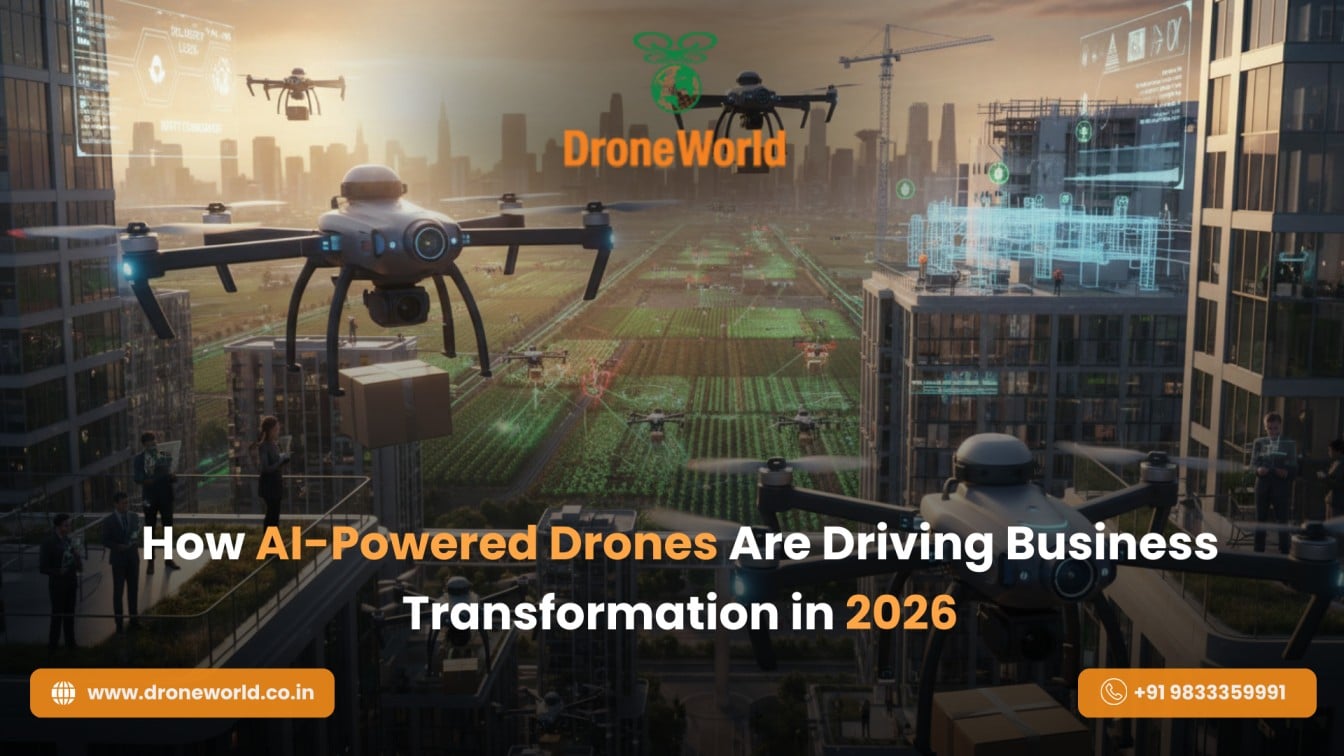
AI-powered drones are transforming how businesses operate in 2026. By combining artificial intelligence, machine learning, computer vision, and autonomous flight systems, modern drones are no longer just flying cameras they are decision-making tools that deliver speed, accuracy, and cost efficiency across industries.
From land surveying and construction to agriculture, logistics, security, and media, AI-driven drones are helping organizations automate operations, reduce human error, and unlock new revenue streams. For students and professionals alike, this transformation is creating high-demand career opportunities and reshaping the future of work
What Are AI-Powered Drones?
AI-powered drones are unmanned aerial vehicles equipped with artificial intelligence algorithms that allow them to analyze data, recognize patterns, make autonomous decisions, and learn from previous flights without constant human control.
Key Capabilities of AI Drones
● Autonomous navigation & obstacle avoidance
● Real-time image & video analytics
● Object detection and classification
● Predictive maintenance insights
● Self-learning flight optimization
These capabilities enable drones to move beyond manual operations into intelligent automation systems.
Why AI-Powered Drones Matter for Businesses in 2026
In 2026, businesses are under pressure to:
● Reduce operational costs
● Improve accuracy and safety
● Make faster, data-driven decisions
AI-powered drones address all three by delivering actionable insights in minutes instead of days.
Business Benefits at a Glance
● Up to 70% reduction in data collection time
● Higher accuracy compared to manual surveys
● Lower workforce risk in hazardous environments
● Scalable operations without increasing manpower
Industry-Wise Business Transformation Using AI Drones
Construction & Infrastructure
AI-powered drones are revolutionizing construction project management.
Key Use Cases
● Automated land surveys & topographic mapping
● Progress monitoring using AI image comparison
● Volume calculation for earthworks
● Safety inspections at heights
Business Impact
● Faster project completion
● Reduced rework costs
● Improved compliance and documentation
For civil engineers and infrastructure firms, drone data integrated with BIM and GIS platforms is becoming an industry standard.
2. Agriculture & Agri-Business
In 2026, precision agriculture is driven by AI drones.
Key Use Cases
● Crop health analysis using multispectral imaging
● Pest and disease detection
● AI-driven spraying recommendations
● Yield prediction
Business Impact
● Reduced fertilizer and pesticide costs
● Increased crop yield
● Sustainable farming practices
For farmers and agri-entrepreneurs, AI drones deliver higher ROI with minimal manual effort.
3. Surveying, Mapping & Geospatial Services
Survey-grade AI drones are transforming geospatial data collection.
Key Use Cases
● High-accuracy drone mapping
● Automated feature extraction
● AI-assisted contour & elevation modeling
● Infrastructure planning
Business Impact
● Survey turnaround time reduced from weeks to days
● Increased project capacity for survey firms
● Higher accuracy than traditional methods
This is creating strong demand for drone survey professionals trained in AI-based photogrammetry.
4. Logistics, Warehousing & Smart Cities
AI-powered drones are enabling faster, smarter urban operations.
Key Use Cases
● Inventory tracking
● Traffic and crowd monitoring
● Infrastructure inspection
● Emergency response support
Business Impact
● Improved operational efficiency
● Real-time monitoring
● Enhanced public safety
Smart cities in 2026 rely heavily on autonomous aerial intelligence.
5. Media, Marketing & Content Creation
For creators and brands, AI drones are reshaping visual storytelling.
Key Use Cases
● AI-assisted cinematic tracking shots
● Automated scene framing
● Event coverage optimization
Business Impact
● Reduced editing time
● Consistent professional output
● Scalable content creation
Content creators gain a competitive edge with AI-assisted drone cinematography skills.
Career Opportunities Created by AI-Powered Drones
AI-powered drones are creating future-proof careers across industries.
High-Demand Roles in 2026
● Drone Pilot & AI Operator
● Drone Survey Specialist
● Agricultural Drone Analyst
● AI Drone Data Engineer
● Commercial Drone Business Owner
Students and professionals trained in AI drone technology enjoy higher employability and freelance opportunities.
Why Businesses Prefer AI-Trained Drone Professionals
Businesses in 2026 are not just hiring drone pilots they need AI-enabled drone experts who can:
● Interpret aerial data
● Operate autonomous systems
● Integrate drone outputs with business workflows
This makes professional drone training essential for anyone entering the industry.
How DroneWorld Prepares You for the AI Drone Future
DroneWorld equips learners with industry-ready AI drone skills through structured training programs designed for real-world applications.
What Sets DroneWorld Apart
● Industry-relevant drone use cases
● Practical exposure to AI-enabled drones
● Compliance-focused training
● Career-oriented learning paths
Whether you are a student, engineer, farmer, entrepreneur, or creator, DroneWorld helps you stay ahead in the AI drone revolution.
Conclusion
AI-powered drones are driving business transformation in 2026 by combining intelligence, automation, and precision. They are helping organizations operate faster, smarter, and safer while creating powerful career opportunities for skilled professionals.
For anyone looking to enter or grow in this space, learning from a trusted training ecosystem like DroneWorld ensures you are prepared not just for today, but for the future of intelligent aerial technology.
FAQs 👍
1. Are AI-powered drones fully autonomous?
AI-powered drones can operate autonomously for specific tasks, but regulatory frameworks still require human supervision for most commercial operations.
2. Do AI drones require special training?
Yes. Professionals need training in AI analytics, drone regulations, and industry-specific applications.
3. Are AI drones expensive for businesses?
Initial investment is higher, but long-term cost savings and efficiency gains make them highly profitable.
4. Which industries benefit most from AI drones?
Construction, agriculture, surveying, logistics, smart cities, and media industries benefit the most.